I came of age at 14, during the second wave of feminism. Back then, reproductive rights, workplace discrimination, equal pay, domestic violence awareness, and the fight for the Equal Rights Amendment defined the women’s movement.
I lived through Title IX in 1972 and the Roe v. Wade decision in 1973, watching women beginning to break into male-dominated fields in record numbers. But I also remember the help-wanted ads still split into “men” and “women” sections through the 1970s and 80s. I remember being asked in job interviews whether I planned to marry or have children. I remember when women were required to wear dresses or skirts to work.
At the center of that fight, always, was Gloria Steinem.
I remember buying my first issue of Ms. Magazine and seeing, for the first time, women of every generation and background celebrated as accomplished, extraordinary individuals.
Gloria gave voice to my anger — anger on behalf of young friends whose lives were upended by unwanted pregnancies because single women couldn’t access birth control, let alone the right to choose abortion.
Her voice, her power, shaped my lifelong mission: advocacy for abortion access and human rights for girls and women.
Gloria didn’t stop with the second wave.
She carried her work into the third wave, where intersectionality, body positivity, and reclaiming language once used against women moved to the forefront. During this wave she, together with Jane Fonda and activist Robin Morgan, founded the Women’s Media Center in 2005, a watchdog organization focused on how women were covered in popular media.
She carried me along with her through my 30s and 40s, when I fought against the glass ceiling and sexist tropes in the workplace as a barrier-breaking woman in tech. My own advocacy kept evolving as hers did. She never stopped growing, never stopped changing, never stopped being our voice.
And in the fourth wave, Gloria kept working.
Our advocacy moved from the streets into digital spaces, amplifying and building on the work of every wave before it. Gloria’s roots in the civil rights movement of the 1960s— standing alongside Black, Latina, Asian, and Indigenous organizers, along with her friendship and partnership with Shirley Chisholm, with whom she founded the National Women’s Political Caucus in 1971 which supported gender equality in presidential politics— laid the foundation for her later work centering on Black feminist scholars as guides for the future.
Gloria was one of the strongest voices that insisted that gender cannot be separated from race, class, sexuality, ability, and trans identity. And she carried me forward as I kept growing in my own feminism, too.
Meeting Gloria, a profound encounter
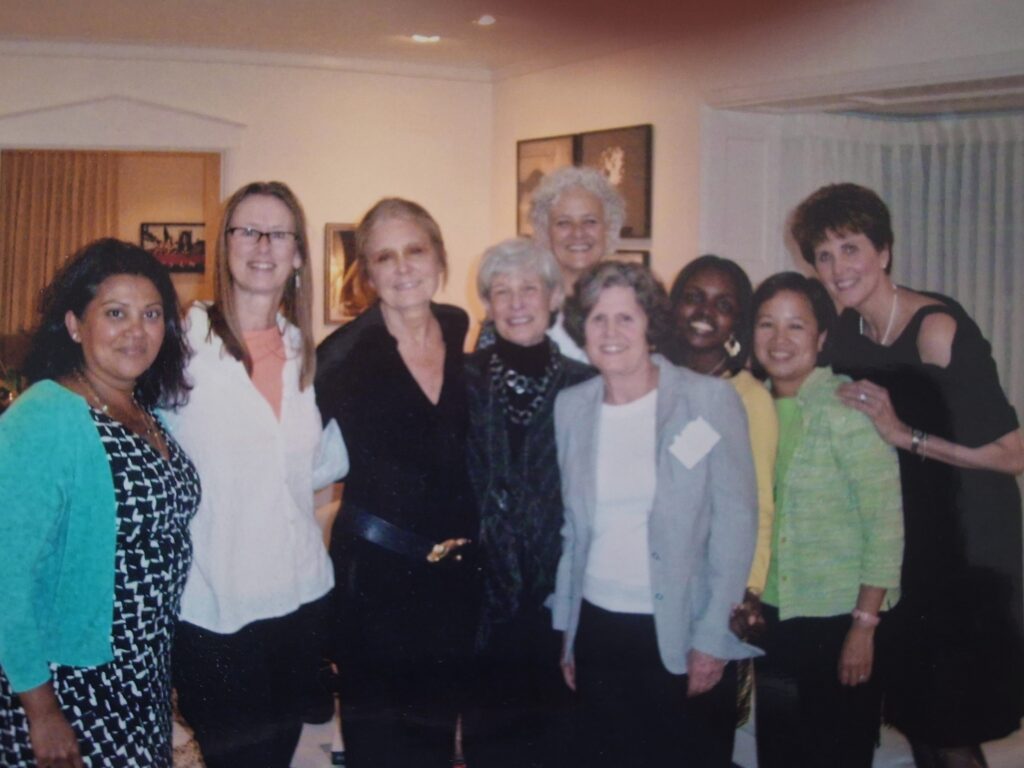
I had the honor of meeting Gloria in the 2000s, while serving on the board of the Planned Parenthood affiliate in St. Louis — now Planned Parenthood Great Rivers.
It was an intimate gathering at the home of Gloria’s friend Helen Kornblum, herself a major supporter of women and a collector of works by women photographers. We sat in a living room full of amazing art, talking about the challenges facing women and girls across every generation and background, and about why we can never stop fighting for them.
I told Gloria how profoundly she had shaped my worldview and my feminist journey, and how grateful I was for everything her work had given girls and women — and would go on giving.
Carrying her legacy forward through advocacy
I carry my advocacy for women and girls forward guided by Gloria’s example. Over the years, I’ve had the honor of serving on the boards of Planned Parenthood of St. Louis (now Great Rivers), Planned Parenthood of the Rocky Mountains, the American Association of University Women, Cobalt Advocates and Cobalt Abortion Fund — which I continue to support — and Pro-Choice Washington. I will never stop. Just as Gloria never stopped.
As I reflect on Gloria Steinem’s legacy, I am moved by her extraordinary ability to grow and adapt, to inspire each new generation, to shape the feminist movement to reflect the reality of their lives.
As I look forward, and as Pro-Choice Washington prepares to grow and rebrand as Northwest Reproductive Equity, I am holding Gloria’s example of dynamic leadership close to my heart. I am inspired to continue working toward her vision of an expansive feminist future where all people are equal and have access to complete bodily autonomy and reproductive freedom.
Gloria’s shoes will never be filled. But everyone she shaped will carry her vision and her advocacy forward, for this generation and the ones still to come. We lost a lioness this week — but her roar will echo for generations.
Melissa Johnsen is the Vice President of Pro-Choice Washington’s Board of Directors. She joined the board in 2022.