For years I’ve explored how investing in public transit can safeguard our environment and vastly improve public and community health. (Among many things, including being an avid abortion advocate, I’m a self-proclaimed train nerd!)
As the Seattle area continues expansions to its public transit, like the Sound Transit Crosslake extension, connecting Redmond, Bellevue, and Seattle over the I-90 floating bridge (the first in the world!), it’s become increasingly clear how a reliable public transit system can be the difference between getting health care or going without.
Income inequality continues to shape access points and who can and can’t receive care. The Guttmacher Institute reports that about 75% of abortion patients are considered low-income, and nearly 20% of low-income Americans don’t have access to their own vehicle. With statistics like that, you can see how public transit becomes a lifeline for abortion patients even in great cities like ours.
When patients have limited options for clinics in their communities and must travel longer distances for care, costs add up to overwhelming totals, and many folks forgo receiving the care they need.
Read more about how much abortions cost in our Abortion Access Guide.
In places where abortion is restricted and public transit is severely underfunded; patients end up in service deserts. Often, abortion seekers are forced to spend hundreds of dollars on rideshares or car rentals, juggle spotty routes, and make multiple transfers on trips that take hours. For example, in our neighboring state of Idaho, an abortion seeker from the capital city of Boise would have to travel 10.5 hours on 4 different buses to reach the nearest clinic offering care in Walla Walla, WA.
Unfortunately, difficulties like this are often a best-case scenario. Transportation barriers can prevent patients from accessing care entirely. For a patient from Idaho Falls, ID, the nearest operating clinic is located in Helena, MT. According to NBC News, there is “no transit available” between the two cities.
With all that’s happening in our world, it can feel difficult to find true moments of progress and truly revel in the hope they bring. Sometimes, however, that takes looking in unexpected places. Our research at Pro-Choice Washington about Seattle’s expanding public transit led us to a new partnership with Transportation Choices Coalition, as we raise awareness for the positive impacts of transit for abortion care during Ride Transit Month. Without forging research into the unexpected intersections of abortion care and other fields, this fruitful partnership would not have been possible.
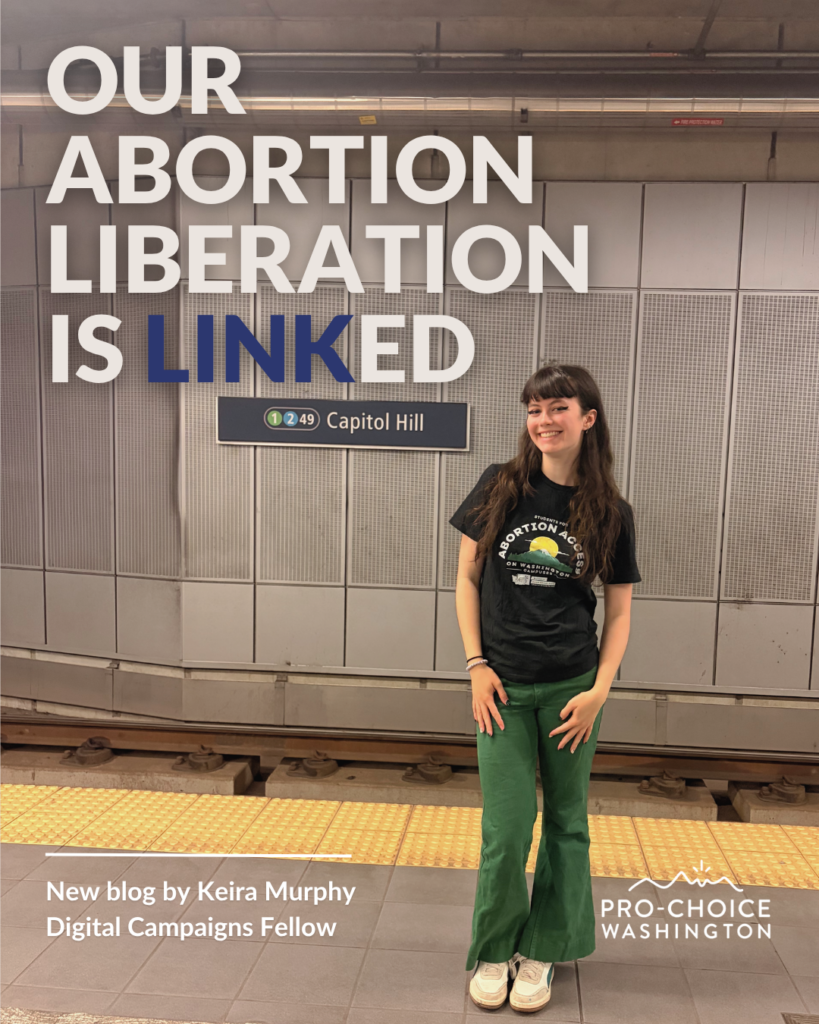
Expansions like the historic new connection on Seattle’s Link 2 line are the kind of coverage all cities need so people of all incomes can reach critical health care services. This shows us that progress is possible—whether it’s on transit systems or abortion access—and serves as a critical reminder of how all these fights are inter-LINKED. (Pun intended!)
When you feel starved for examples of progress and reminders of why it truly counts to invest in advocacy work, widening the scope of understanding a particular issue can open up a world of hope. No fight can be won in isolation.
I encourage you to show your support for reproductive justice while you keep your eyes open for moments of unexpected connection.
Make your contribution today!
Keira Murphy is a fellow at Pro-Choice Washington, an advocacy organization working to expand access to abortion and reproductive health care. Her research focuses on the intersection of feminist analysis and environmental and community health, and how these lenses can be applied to improve the lives and well-being of all women and LGBTQ+ individuals.